Let's Talk!
Thank you for being here. My goal with my photography has always been to share my experiences and my unique perspective with you. I want to focus more of my energy on delivering in-depth, intentional content to you. I hope a specifically curated newsletter, delivered directly to your inbox proves to be valuable to you.
Please let me know your thoughts. Really. I want to know what you think about the content I am delivering in my quarterly newsletters. Do you want to see something else? Do you want to hear from me more often or less often? Is there a specific topic you want me to talk more about? Is there a trip I have taken that you want to hear more about?
Please send me a message here or send an email with your input.
I genuinely want to hear from you!
I genuinely want to hear from you!
Summer is Upon Us!
For those of us here in Northern Nevada, it felt like the winter weather was never going to relent. Springtime was unpredictable and inconsistent. Suddenly it is 90 degrees and we are wishing for Autumn weather! The good thing about summertime is the abundance of neighborhood critters. Lately I have found myself stopping to observe the non-human life that we share our space with more and more.
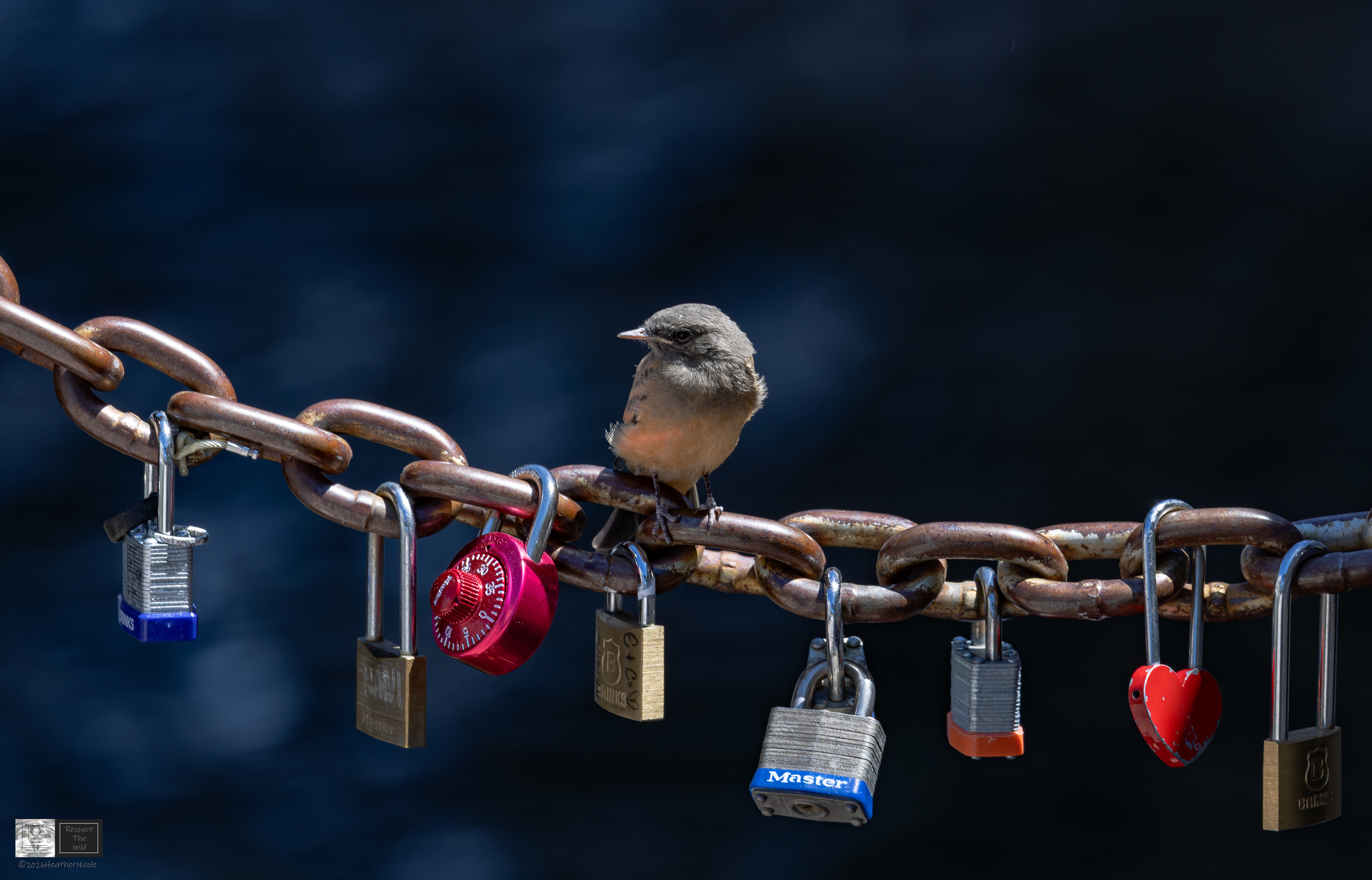
While on a lunchtime walk through downtown recently, I saw a mother Says Phoebe with her two fledglings. The youngsters were practicing flying short distances and using this chain as a resting spot. They were even learning to hunt and already catching bugs! Mamma was doing a great job!
From my brief time I spent outside documenting the urban wildlife, this image stuck out to me the most. I love the juxtaposition of the small bird standing on a chain lined with locks that are the same size as her. I love that nature is standing atop this man-made item decorated with objects of symbolism and meaning. (Notice the lock on the far left with two wedding rings?)
From my brief time I spent outside documenting the urban wildlife, this image stuck out to me the most. I love the juxtaposition of the small bird standing on a chain lined with locks that are the same size as her. I love that nature is standing atop this man-made item decorated with objects of symbolism and meaning. (Notice the lock on the far left with two wedding rings?)
How often do little birdies use this chain to rest, enjoy a bug they just caught, or seek shelter from the blazing sun? How often to humans visit this chain to see if their lock is still there and reflect on the moments that led them to this place?
Small objects and seemingly insignificant locations like this one hold great meaning. Whether it is a little birdie learning to fly, or a young couple learning to love, it is equally relevant and equally important. We just need to take a moment to observe and we will notice little magical moments all around us.
©MomentsbyHeatherNicole

ANNOUNCEMENTS!
Looking At You!
©MomentsbyHeatherNicole
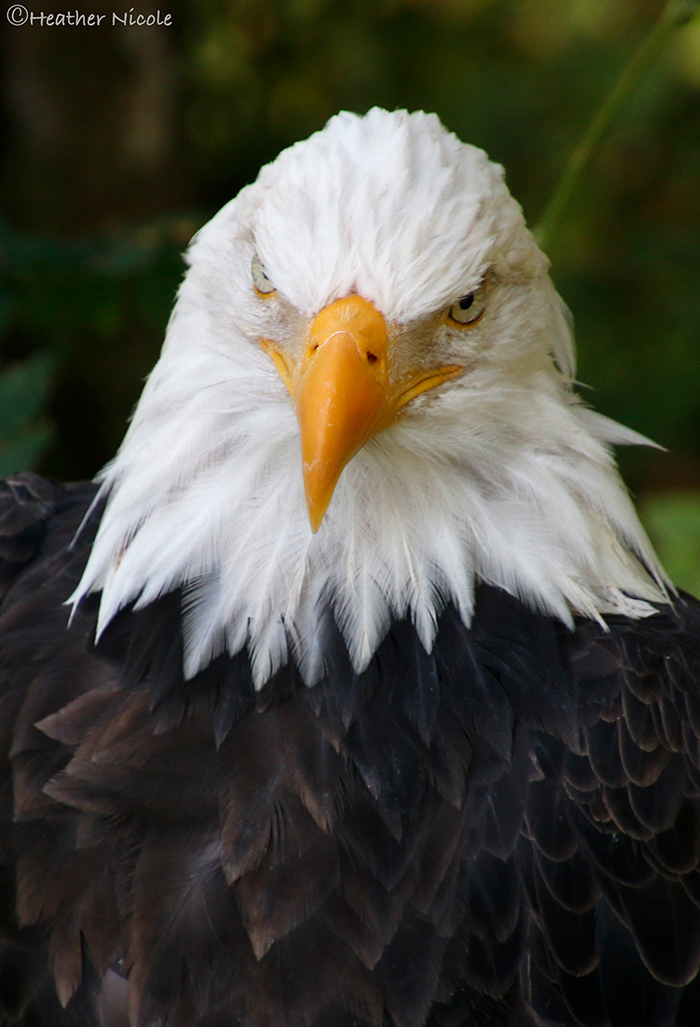
The Eagle Demands Your Attention!
Reno Tahoe International Art Show
RTIA Show: Edition 5
September 17-20
September 17-20
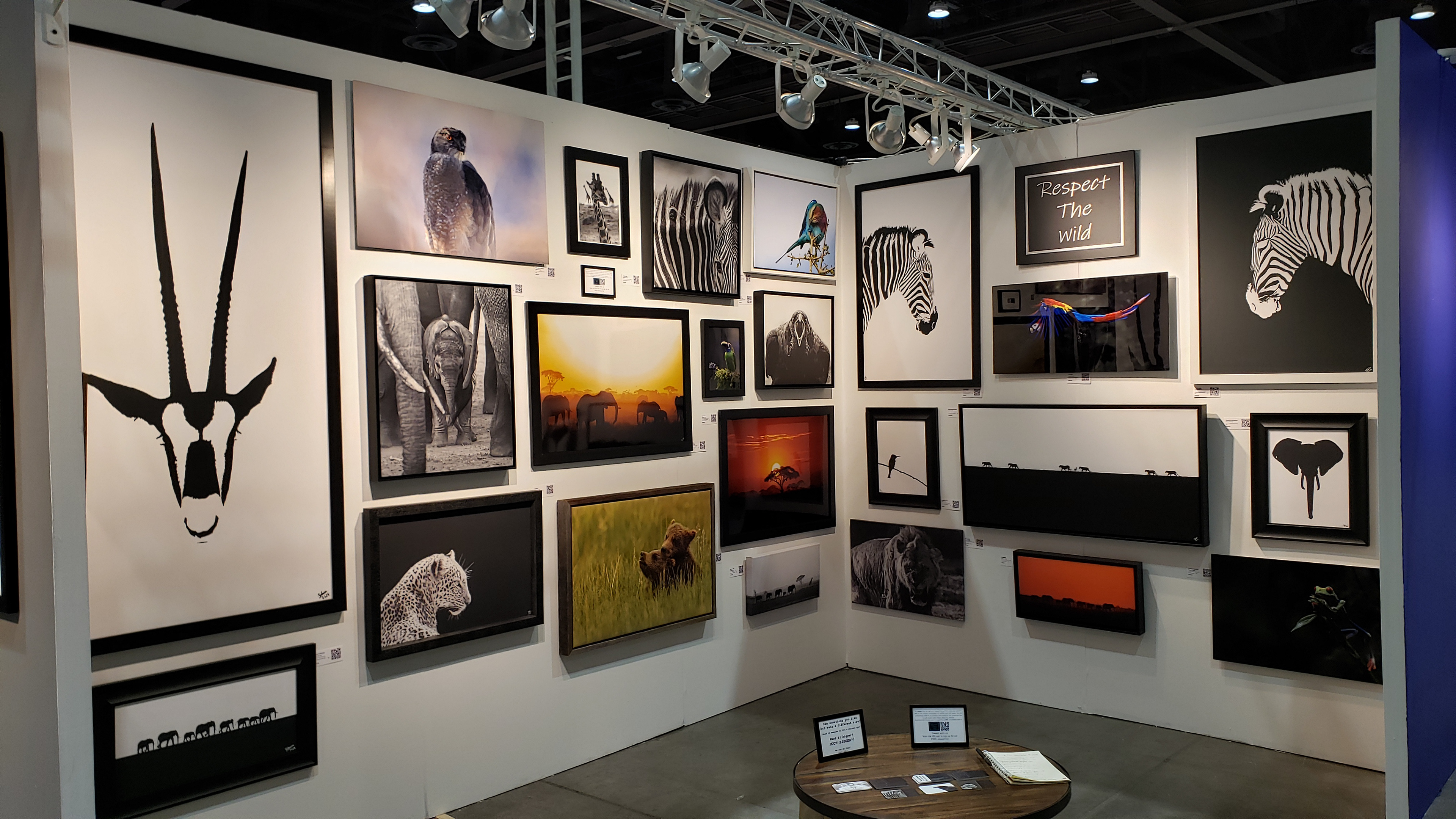
Respect The Wild (a.k.a Andrew C. Strom and I) will be exhibiting at the RTIA again this year! Last year was so much fun. We met so many great people and made a lot of wonderful connections. We would love to see you there!
Tickets are available now!
Click HERE to order yours today!
Click HERE to order yours today!
Use Code "WHOKNEW26" for a 20% friends and family discount!
©RespectTheWild
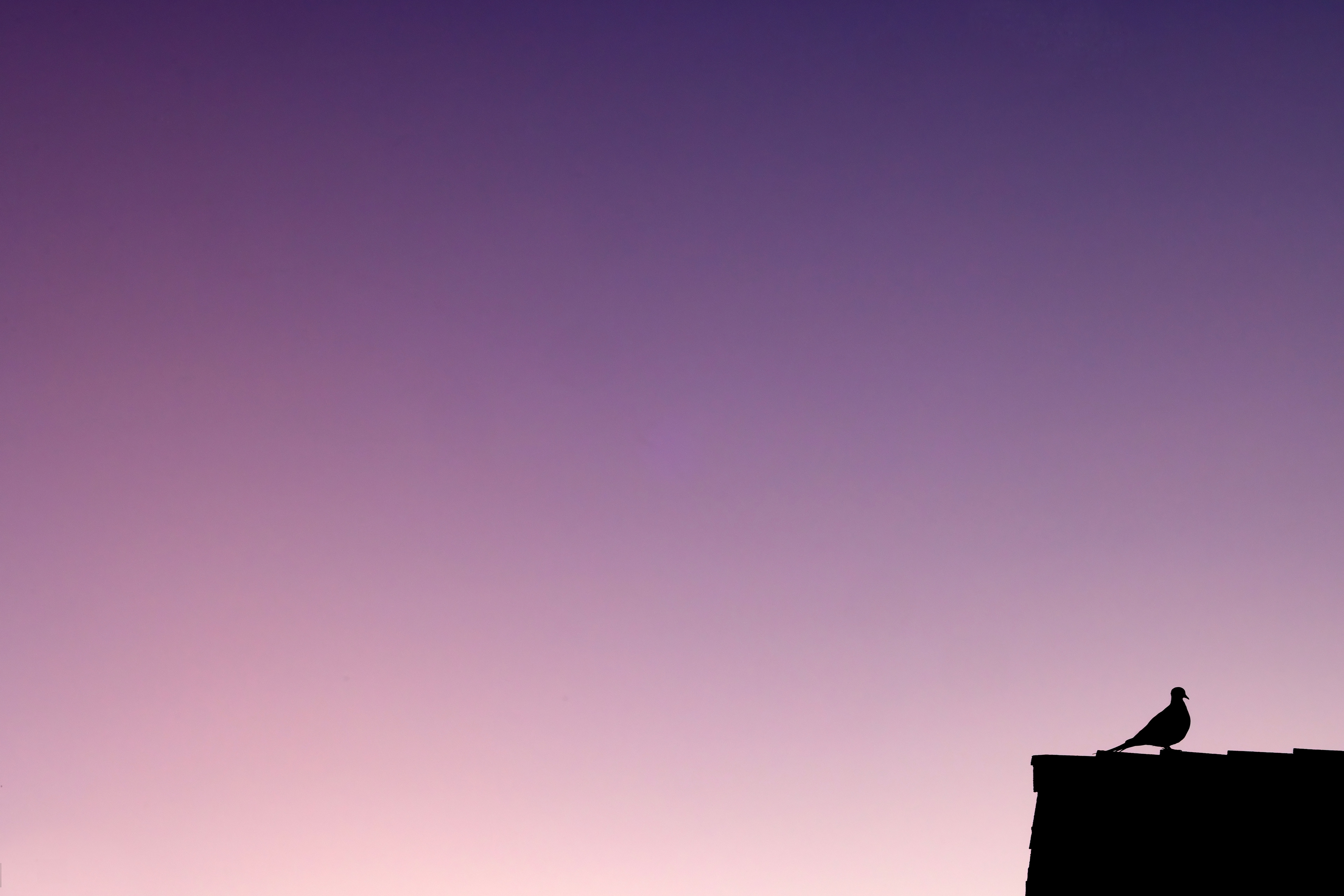
Minimal Mourning
©MomentsbyHeatherNicole
©MomentsbyHeatherNicole
Excellence Award
"Minimal Mourning"
Accent Gallery - Lavender and Silver Show
Accent Gallery - Lavender and Silver Show
Click HERE to view the online exhibit.
Excellence Award
"It IS Easy Being Green!"
Accent Gallery - Multicolor Show
Accent Gallery - Multicolor Show
Click HERE to view the online exhibit.
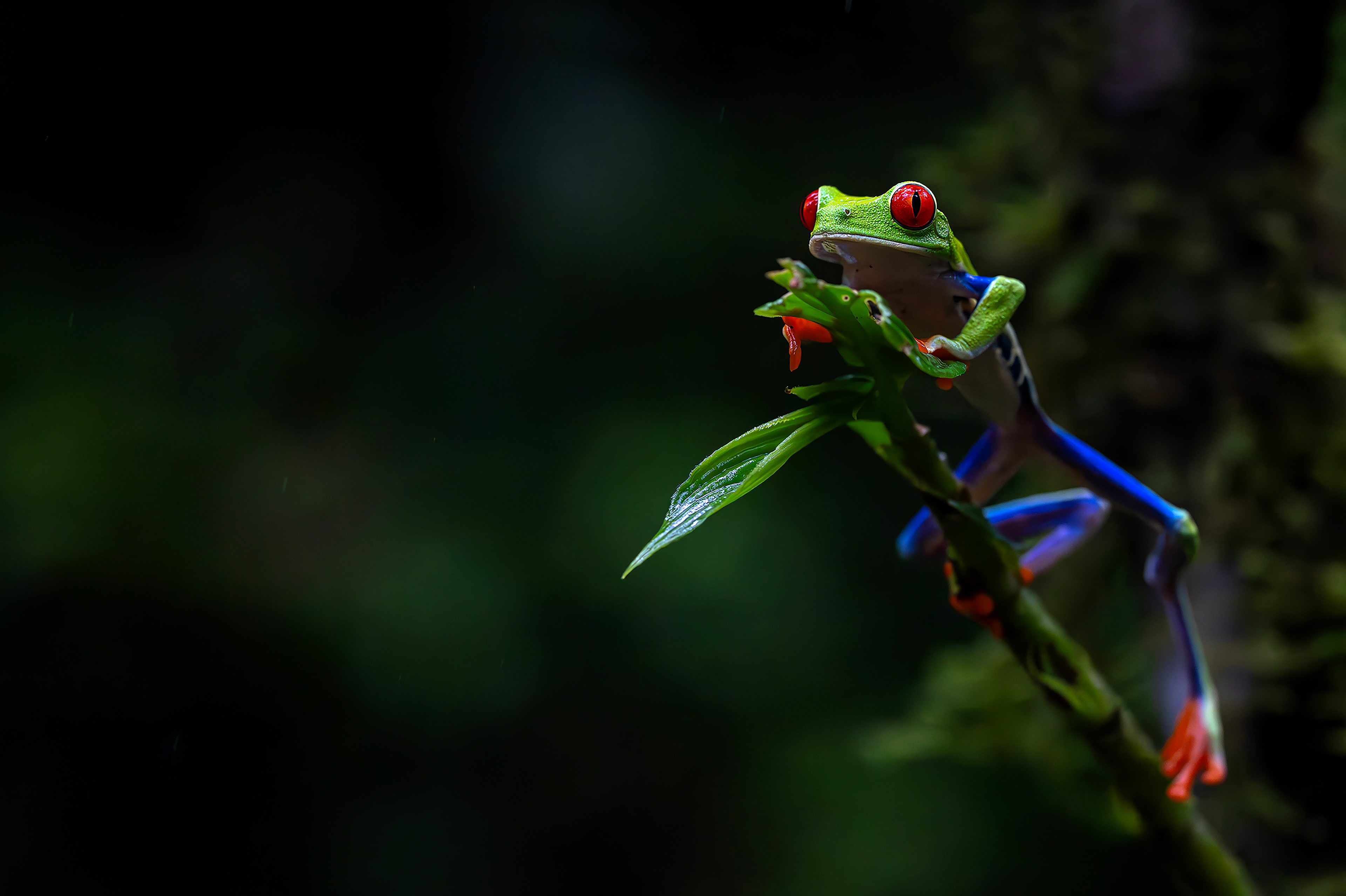
It IS Easy Being Green!
©MomentsbyHeatherNicole
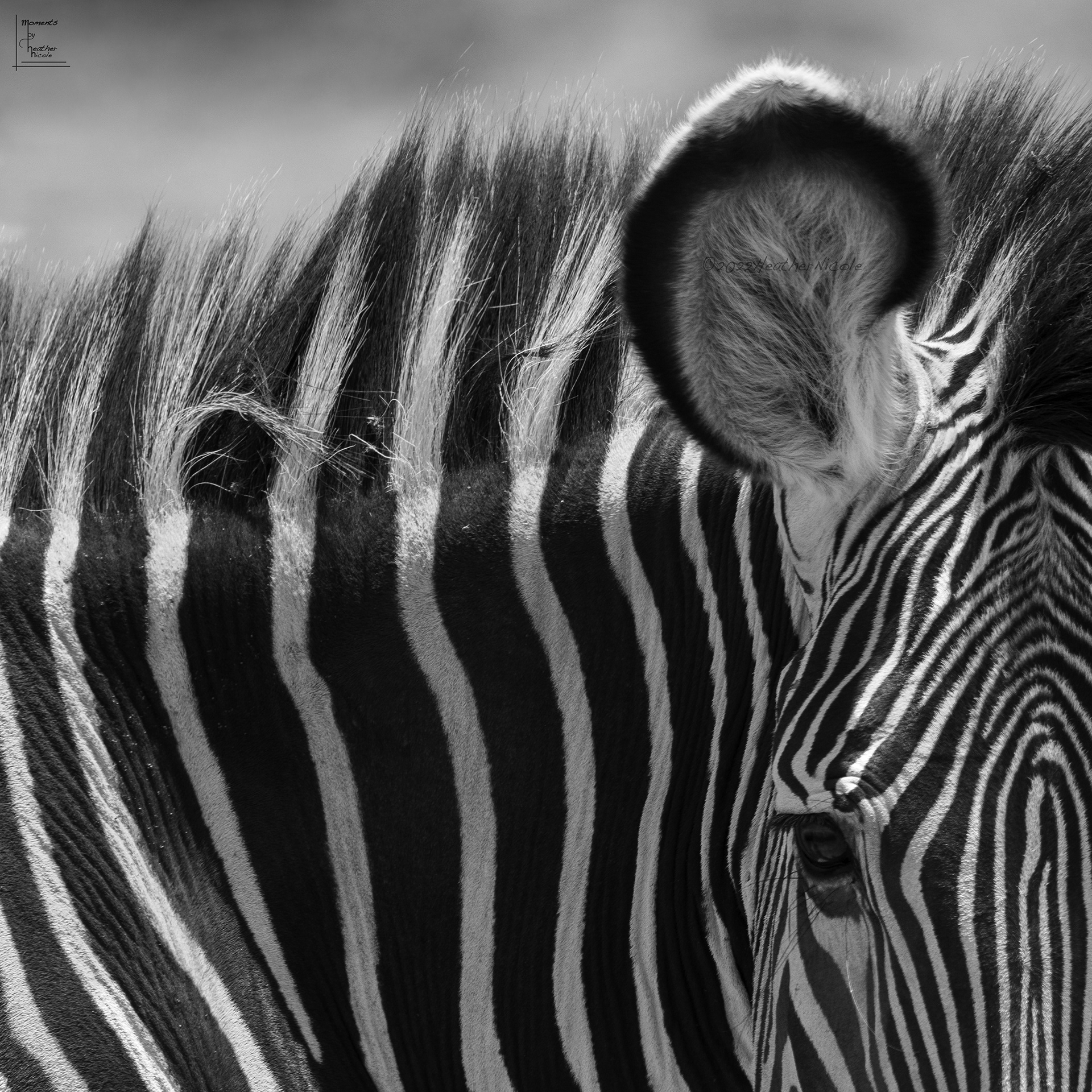
Grevy's Gaze
©MomentsbyHeatherNicole
Finalist
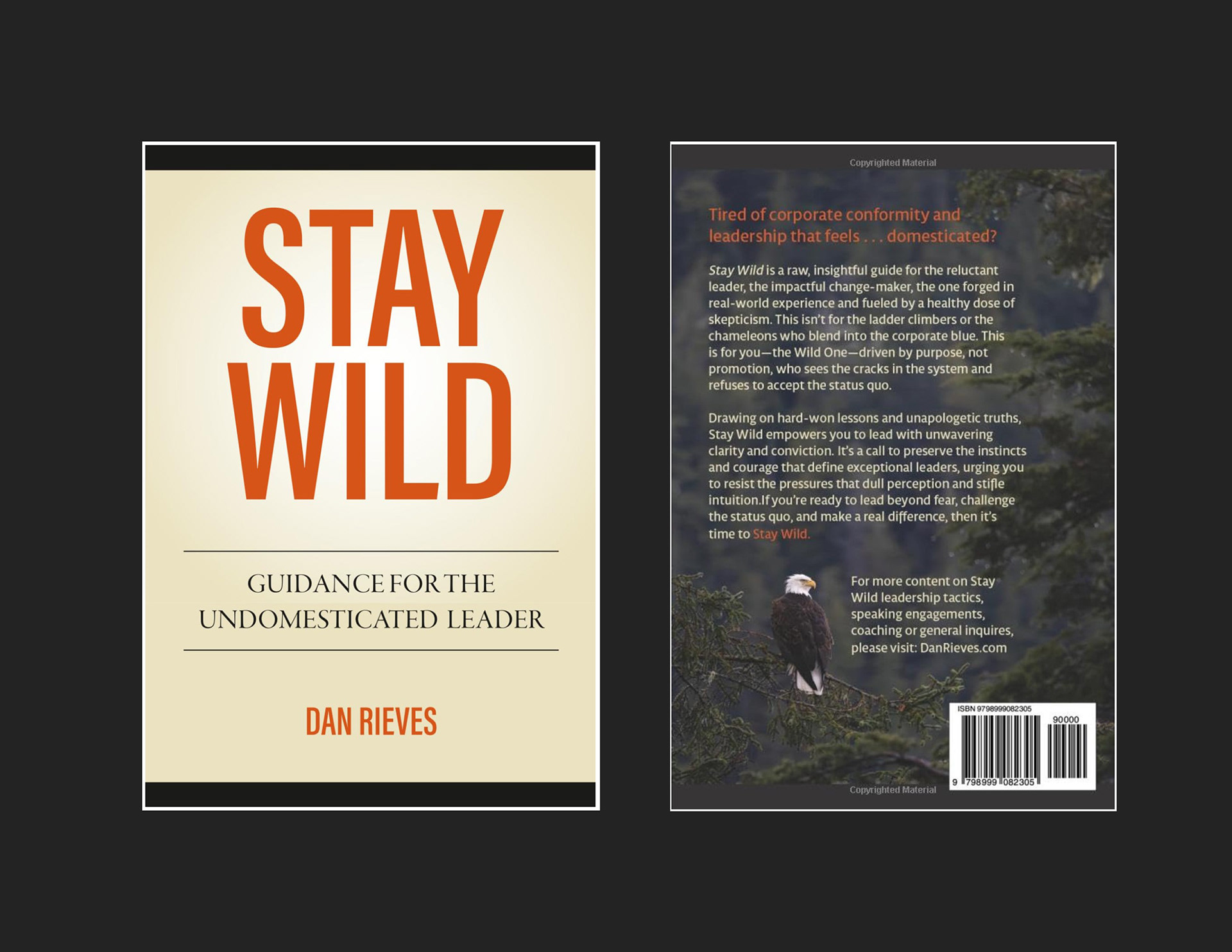
Stay Wild - Guidance of the Undomesticated Leader is available for purchase now!
This fantastic guide book, written by Dan Rieves, offers excellent guidance and advice for anyone wanting to break through corporate conformity.
And it features my photography throughout the book!
And it features my photography throughout the book!
Click here to order yours!

Conservation Corner
World Conservation Day is July 28th
So Let's Have a Conversation About Conservation Photography
So Let's Have a Conversation About Conservation Photography
When we hear "conservation photographer" we may immediately think about famous National Geographic photographers such as Cristina Mittermeier ("Mitty") or Paul Nicklen. As a photographer myself, the title "conservation photographer" feels a little unattainable.
Confession: I don't feel like I can make a difference with my photography.
I am not famous by any means. I don't have the reach to have a photo go viral or to get global or even national recognition for my work. Therefore, I don't feel like I can call myself a conservation photographer.
This is a flawed way of thinking. This is IMPOSTER SYNDROME!
Yes, I am guilty of it! So, let's change the narrative.
Let's start with the facts. What is conservation photography?
Conservation Photography is, at its core, sharing information and spreading awareness about a conservation related issue or topic. Conservation Photography furthers environmental, wildlife, habitat, or cultural conservation by expanding public awareness of issues and stimulating remedial action. Simply put, if you are a photographer who shares photos accompanied by factual information about a conservation related topic, you ARE a conservation photographer!
And you don't need to travel the world to be an advocate for a conservation topic. In fact, there are stories happening in our neighborhoods that are begging to be told!
With that in mind, I would bee honored to share a story that unfolded in my backyard.
Confession: I don't feel like I can make a difference with my photography.
I am not famous by any means. I don't have the reach to have a photo go viral or to get global or even national recognition for my work. Therefore, I don't feel like I can call myself a conservation photographer.
This is a flawed way of thinking. This is IMPOSTER SYNDROME!
Yes, I am guilty of it! So, let's change the narrative.
Let's start with the facts. What is conservation photography?
Conservation Photography is, at its core, sharing information and spreading awareness about a conservation related issue or topic. Conservation Photography furthers environmental, wildlife, habitat, or cultural conservation by expanding public awareness of issues and stimulating remedial action. Simply put, if you are a photographer who shares photos accompanied by factual information about a conservation related topic, you ARE a conservation photographer!
And you don't need to travel the world to be an advocate for a conservation topic. In fact, there are stories happening in our neighborhoods that are begging to be told!
With that in mind, I would bee honored to share a story that unfolded in my backyard.
🐝
Introducing: The Leafcutter Bee!
Did you know, there are over 1,500 species worldwide, with up to 240 species native to North America? If you had asked me a few weeks ago "What do you know about leafcutter bees?" I would have responded with "What is a leafcutter bee?" About a month ago I noticed these very busy bees zig-zagging around the backyard patio. Since then I have been obsessed! Lately, all of my down time is spent watching, photographing, and researching these adorable bees!
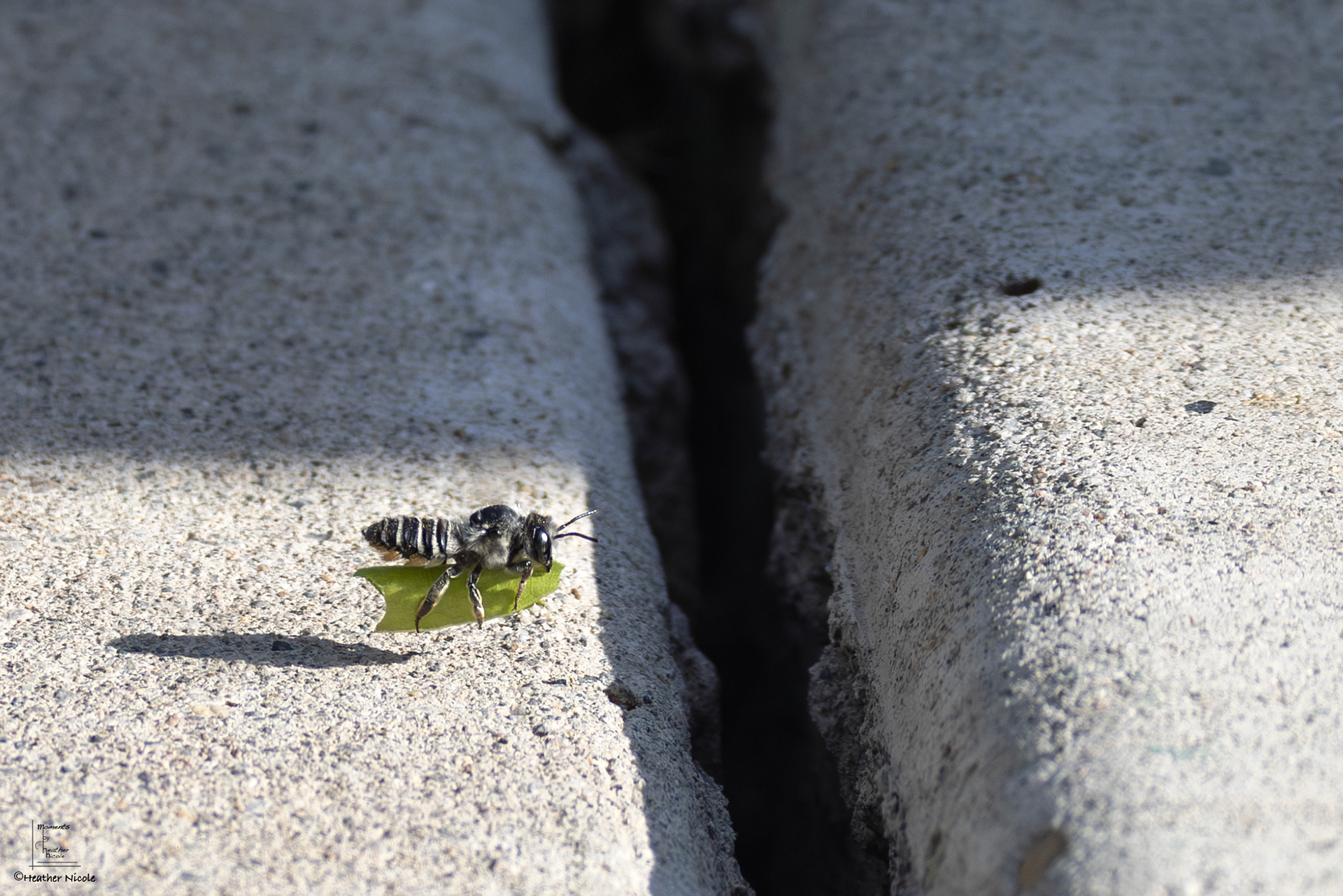
Leafcutter Bee
©MomentsbyHeatherNicole
Leafcutter Bees (megachile) don’t live in large colonies as honey bees do; there is no queen bee. Most are solitary, meaning that each mother takes care of her own brood. They nest in a variety of cavities in wood or hollow stems. There are even some that nest underground, like this ⬆️⬇️ lovely lady! She is building her nest in a crack in the pavement! So cool!
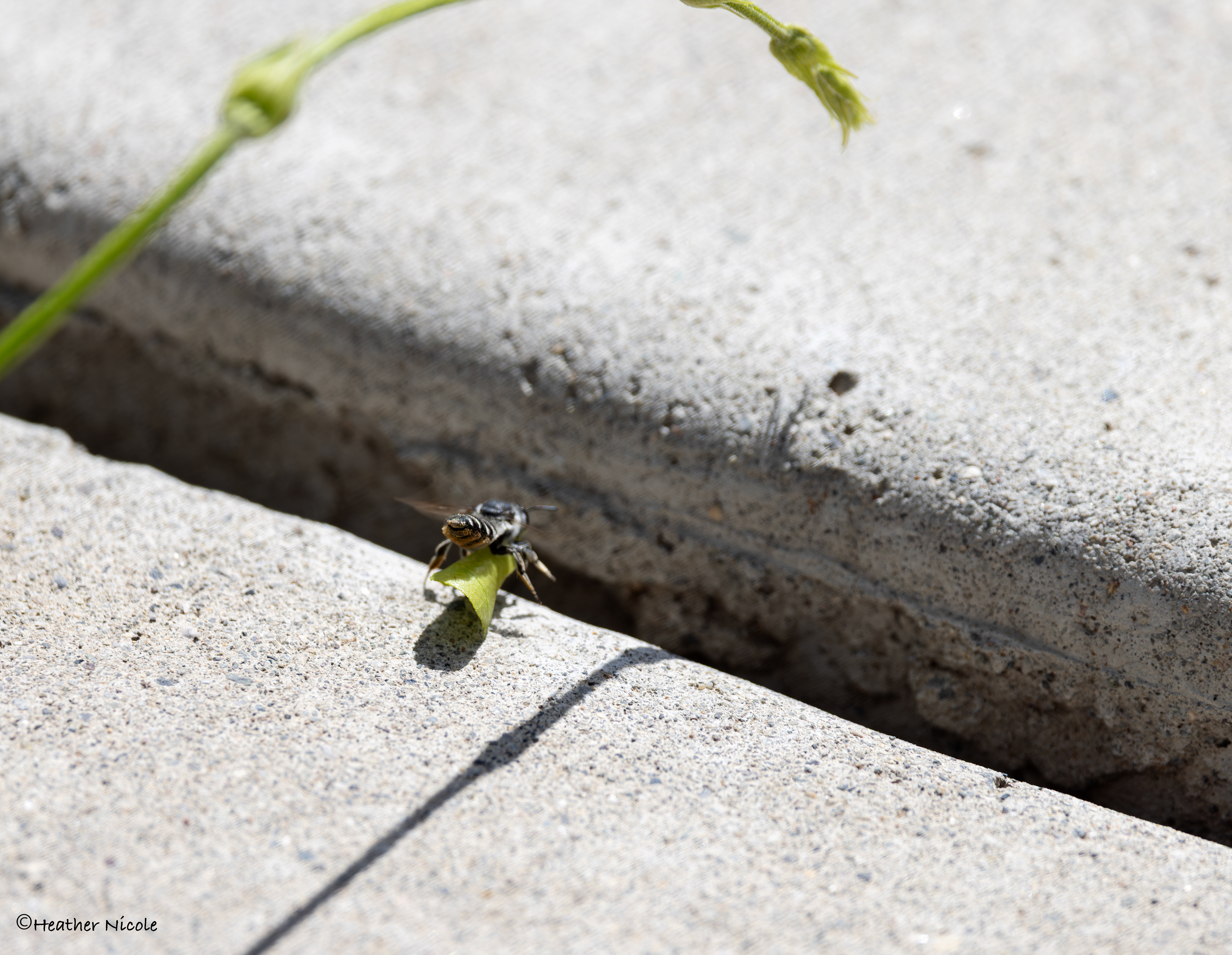
Leafcutter bee bringing a leaf into her nest.
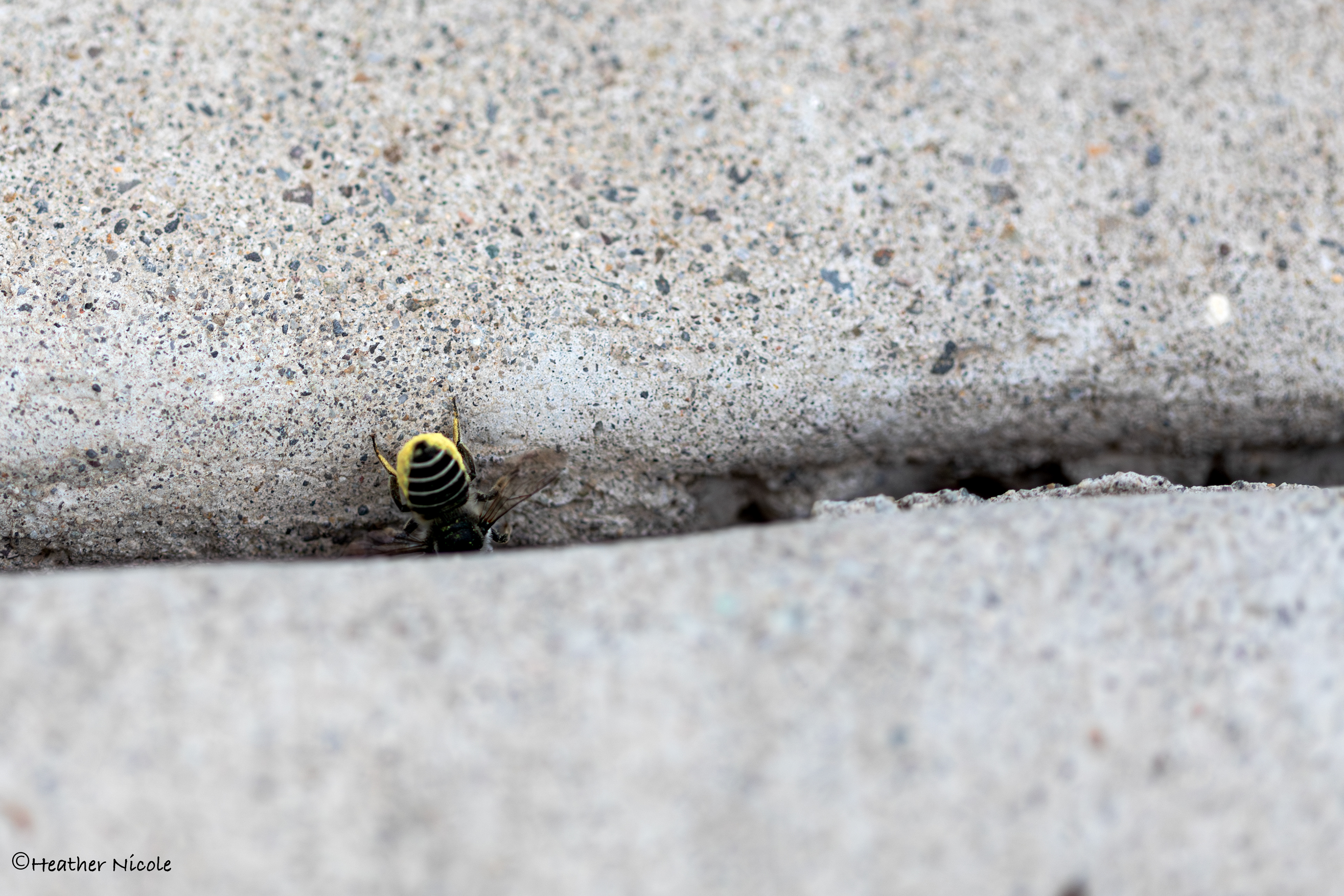
A pollen covered bee butt!
The mother megachile bee brings pollen to the nest (look at that bright yellow pollinated bee butt!) and some nectar in her crop. She kneads the mixture into a bee loaf, adding some of her saliva, which may contain antibacterial and fungicidal substances. It takes many loads to build up a bee loaf large enough to feed one grub from egg to mature size. She diligently visits numerous flowers on her quest to gather the necessary pollen and nectar. When there is enough food, she lays an egg on top. Then she seals that small chamber with chewed up leaves.
If you notice nearly perfect round holes in the leaves of your rose bushes, do not begrudge them that little material that they need to raise their families. She repeats this process of making bee loaves, laying eggs and building partitions until the entire nest hole is full. Then, she builds a final, thicker wall. Shortly afterwards she dies. The next generation feeds on the pollen and nectar bee loaf, grows, and metamorphoses into an adult that remains dormant until the next spring when it chews its way out, mates and is ready to start the circle of life all over again. Both adult males and females emerge in the spring and soon mate.
If you notice nearly perfect round holes in the leaves of your rose bushes, do not begrudge them that little material that they need to raise their families. She repeats this process of making bee loaves, laying eggs and building partitions until the entire nest hole is full. Then, she builds a final, thicker wall. Shortly afterwards she dies. The next generation feeds on the pollen and nectar bee loaf, grows, and metamorphoses into an adult that remains dormant until the next spring when it chews its way out, mates and is ready to start the circle of life all over again. Both adult males and females emerge in the spring and soon mate.
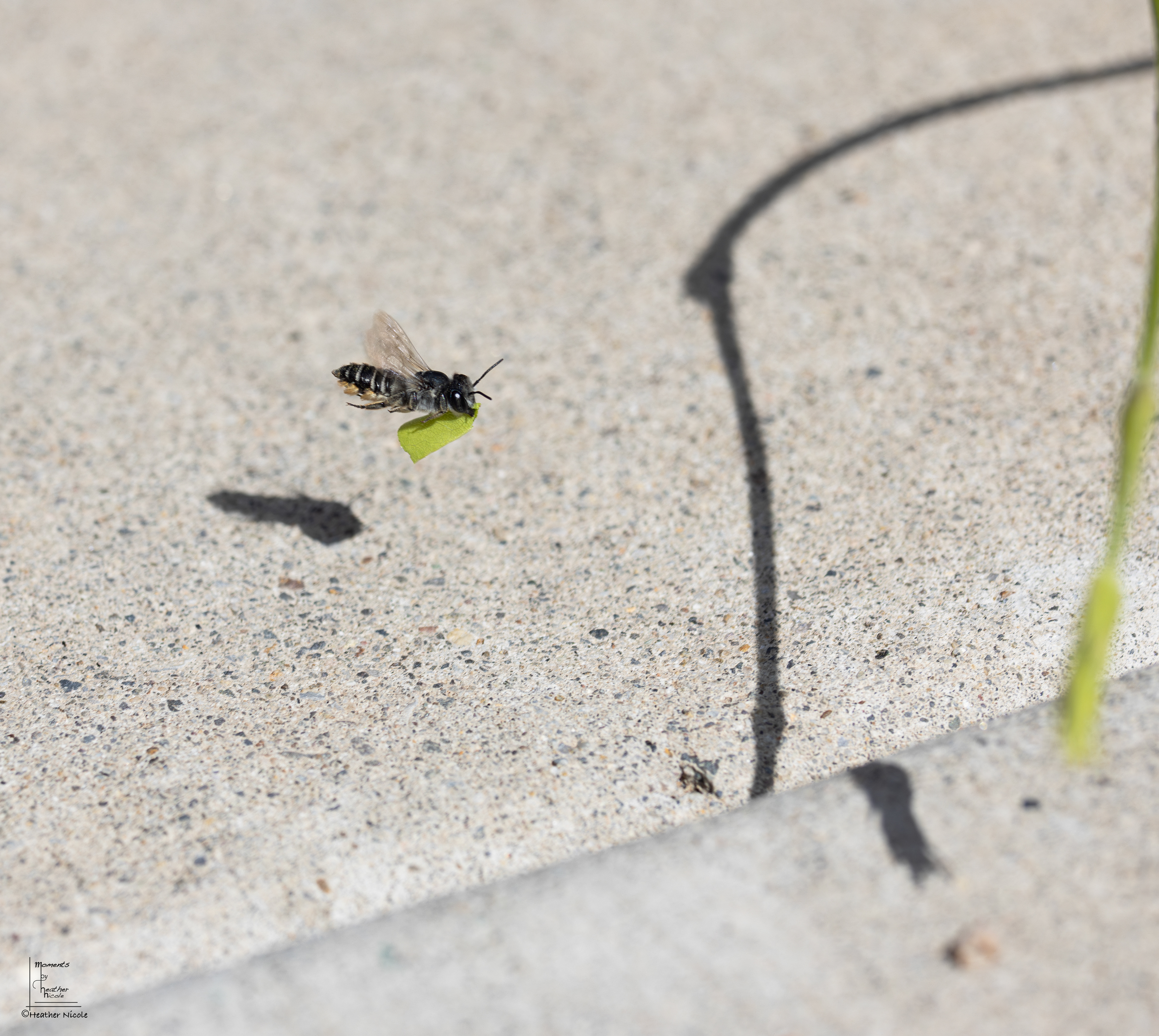
Based on my research, I believe this specific leafcutter bee species is a Flat-tailed Leafcutter Bee (Megachile Mendica.) Flat-tailed Leafcutters are hard to miss: they buzz loudly when flying and foraging for pollen. Once inside flowers, females tend to whirl around, vibrating energetically. This method of shaking pollen loose makes Flat-tailed Leafcutters particularly efficient pollinators! The female Flat-tailed Leafcutter constructs its nest as a series of chambers. Eggs for female offspring, which take longer to develop, are stored in the innermost and most protected chambers, while eggs for males are kept closer to the nest entrance. Adult males only live for up to 14 days. Therefore, they are kept close to the nest entrance so they can emerge from the nest first and find a mate.
Female Flat-tailed Leafcutters often can been seen flying low over the ground in a characteristic zig-zagging pattern. They do this in order to find cavities in hollow stems and sticks to use as nesting places. The zig-zagging flight pattern is exactly what drew my attention to these fascinating bees!
The nests of flat-tailed leafcutters are sometimes preyed upon by Cuckoo leafcutters (genus Coelioxys.) Cuckoo bees defy this conventional archetype — they are kleptoparasites!
Rather than toil away building and provisioning nests for her young, a cuckoo bee will instead rely on the efforts of other bees, and lay her egg in another bee's nest.
Rather than toil away building and provisioning nests for her young, a cuckoo bee will instead rely on the efforts of other bees, and lay her egg in another bee's nest.
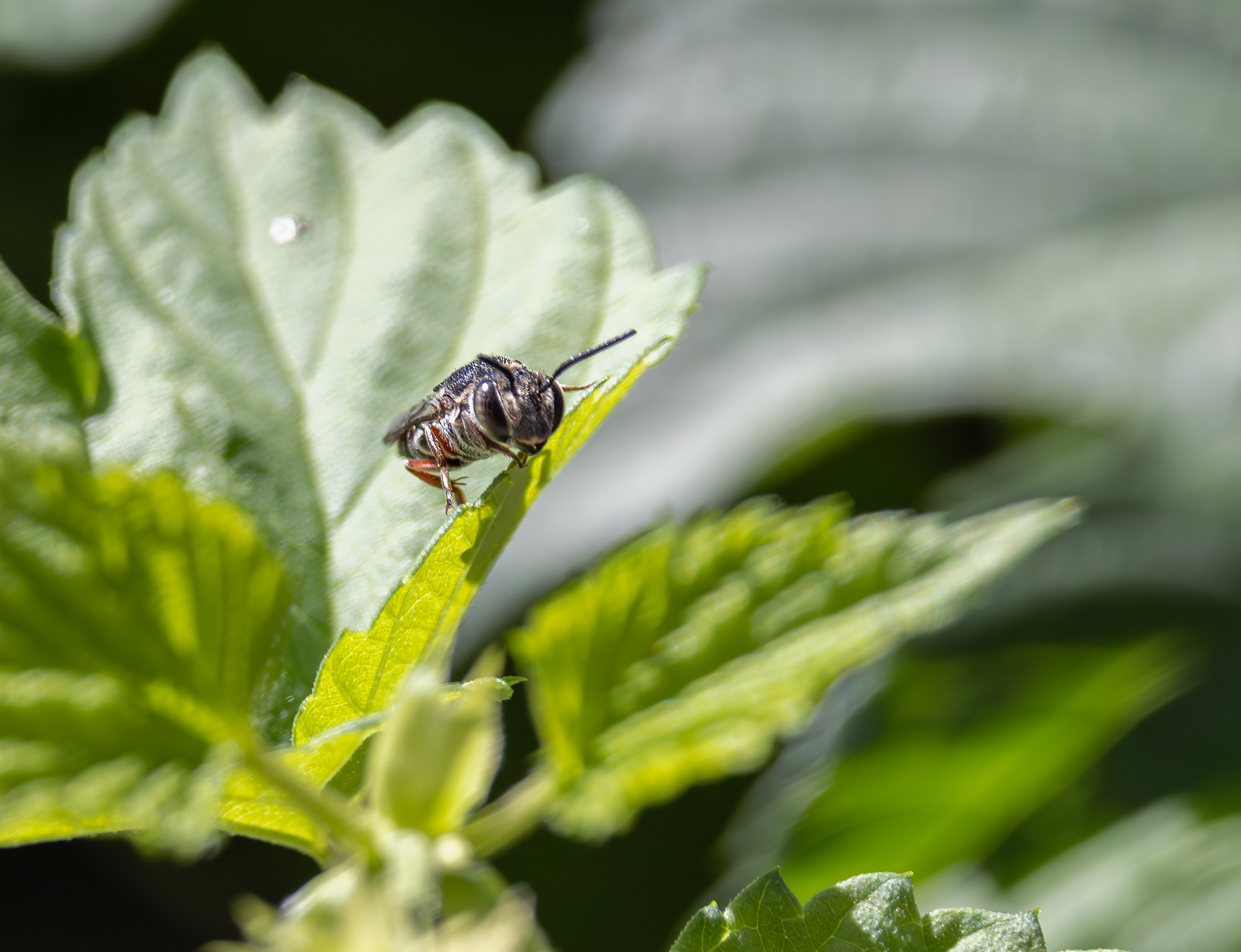
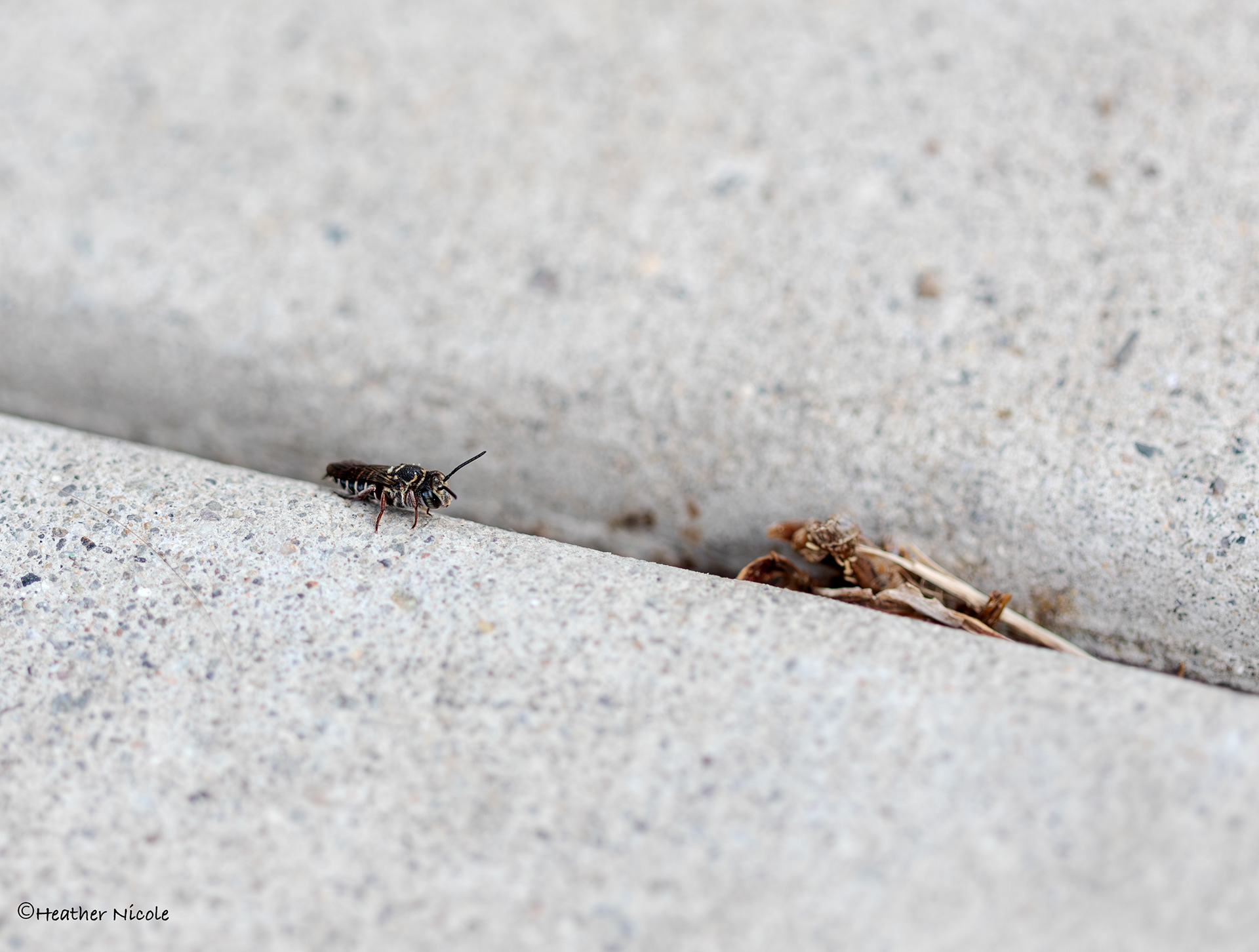
Pictured here ⬆️ is a Sharptail Cuckoo bee (genus Coelioxys.)
When I first noticed them, I thought they were young leafcutter bees emerging from the nest because I always noticed them hovering around the entrance. Then I learned that male leafcutter bees have green eyes so I thought these little green-eyed cuties must be males. Then more photo identification lead me down several more bee shaped rabbit-holes and I learned that these are in fact, Sharptail Cuckoo Bees.
Sharptail Cuckoo bees are solitary, kleptoparasitic insects that lack pollen-collecting hairs and rely on host species to raise their young. Females spend their time flying low to the ground searching for nest entrances, hanging out on flowers to drink nectar and spot potential hosts, or waiting outside a nest entrance for the female leafcutter to leave before she enters and lays her eggs. Sharptails use their sharp, cone-shaped abdomens to pierce sealed leafcutter bee brood chambers, where they lay their eggs. The hatched larvae consume the host's food stores and eggs. This is brood parasitism, an intriguing strategy more commonly associated with their wasp cousins. Cuckoo birds exhibit the same "brood-parasitic" behavior.
When I first noticed them, I thought they were young leafcutter bees emerging from the nest because I always noticed them hovering around the entrance. Then I learned that male leafcutter bees have green eyes so I thought these little green-eyed cuties must be males. Then more photo identification lead me down several more bee shaped rabbit-holes and I learned that these are in fact, Sharptail Cuckoo Bees.
Sharptail Cuckoo bees are solitary, kleptoparasitic insects that lack pollen-collecting hairs and rely on host species to raise their young. Females spend their time flying low to the ground searching for nest entrances, hanging out on flowers to drink nectar and spot potential hosts, or waiting outside a nest entrance for the female leafcutter to leave before she enters and lays her eggs. Sharptails use their sharp, cone-shaped abdomens to pierce sealed leafcutter bee brood chambers, where they lay their eggs. The hatched larvae consume the host's food stores and eggs. This is brood parasitism, an intriguing strategy more commonly associated with their wasp cousins. Cuckoo birds exhibit the same "brood-parasitic" behavior.
Did you know about these bee species? I didn't until about a month ago. Now I want to learn more about the gentle leafcutter bees so I can do more to protect and preserve them. Did yo know you can buy broods of leafcutter bees? Leafcutter bees are beneficial insects. The holes they cut in leaves are not damaging to the plant. They are very efficient pollinators, therefore, they are worth protecting!
Conservation photography isn't about sharing the happiest stories or the most beautiful photos, but it is always fascinating! The intent is to share facts and spread awareness. You don't have to be a photographer to make a difference. Share stories you care about from trusted sources. Avoid sharing AI generated content. Share facts. Spread awareness.
We can all be stewards for our planet and all of the fascinating creatures we share it with.
All things are connected.
All things are connected.
References: Wikipedia, SageLandCollaborative.org, USDA.gov, SharpEatmanGuides.com

Featured Feature!
I am excited to introduce you to a very talented artist, Rick Pott. I first met Rick at a local art gallery. Here in Northern Nevada, there is no shortage of 'Western Art' which very often includes horses. In this flooded market where everyone is in love with the wild horses, Rick's photography stood out to me. His photos of horses felt different. They made me stop. They pulled me in and left me wanting more. I was thrilled when he accepted my offer to feature him in my newsletter and even more thrilled when he sent me the photo he wanted to showcase. Rick has been leaning into landscapes and nightscapes lately and once again, Rick's images have given me pause. The intention and specificity in his work is stunning.
Please enjoy.
Please enjoy.
Rick Pott
Bio: I began this photography journey in 2020, shaped largely by time spent exploring the landscapes of Nevada and the Sierra Nevada. Wide desert valleys, quiet alpine lakes, and weather-worn mountain ridges have a way of slowing things down and sharpening awareness. Over time, the camera became a tool not just for documenting these places, but for noticing the subtle moments within them. I’m drawn to scenes that feel calm, honest, and fleeting. Whether working in the high country of the Sierra, the open spaces of Nevada, or beneath dark night skies, I’m less interested in spectacle than in the feeling of presence—what it’s like to stand there, quietly, in that moment.
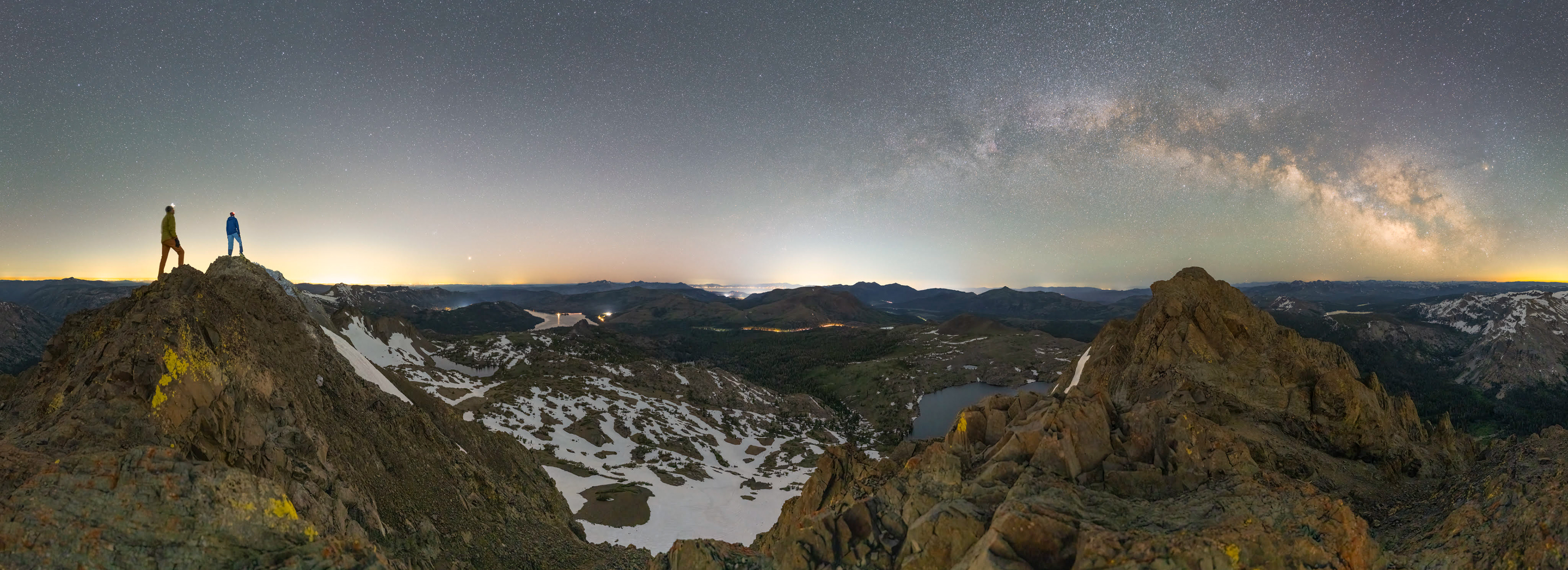
©RickPott
The Story Behind the Image
"Being fascinated by all things space since childhood, it seems natural that I would eventually fall in love with photographing the night sky.
"Being fascinated by all things space since childhood, it seems natural that I would eventually fall in love with photographing the night sky.
A little over two years ago, I envisioned creating a full 360° panorama beneath the early-season Milky Way from the summit of Round Top Peak. Like many landscape photographs, the image didn't happen on my schedule. Snow lingered longer than expected one year, then wildfire smoke spoiled conditions the next. The idea remained, waiting for the right opportunity.
This past June, my oldest son and I hiked to the 10,381-foot summit, arriving just before sunset. As daylight faded, I set up my camera and waited for darkness to settle over the Sierra. Standing on that rocky summit under a sky filled with countless stars is an experience that's difficult to put into words. The silence, the cool mountain air, and the feeling of being surrounded by something so much larger than ourselves has a way of putting life into perspective.
This panorama is more than a photograph to me. It's the realization of a vision that took over two years to complete, and a reminder that some of the most meaningful images aren't just about the final result, they're about the experience of being there, especially when it's shared with someone you love." — Rick Pott
To learn more about Rick and see more of his beautiful art, please visit his website:
https://www.rickpottphotography.com/
https://www.rickpottphotography.com/
Do you or someone you know want to be featured? Let's talk!
Contact me here to get in touch.
Contact me here to get in touch.

Photo Fact!
Leading Lines
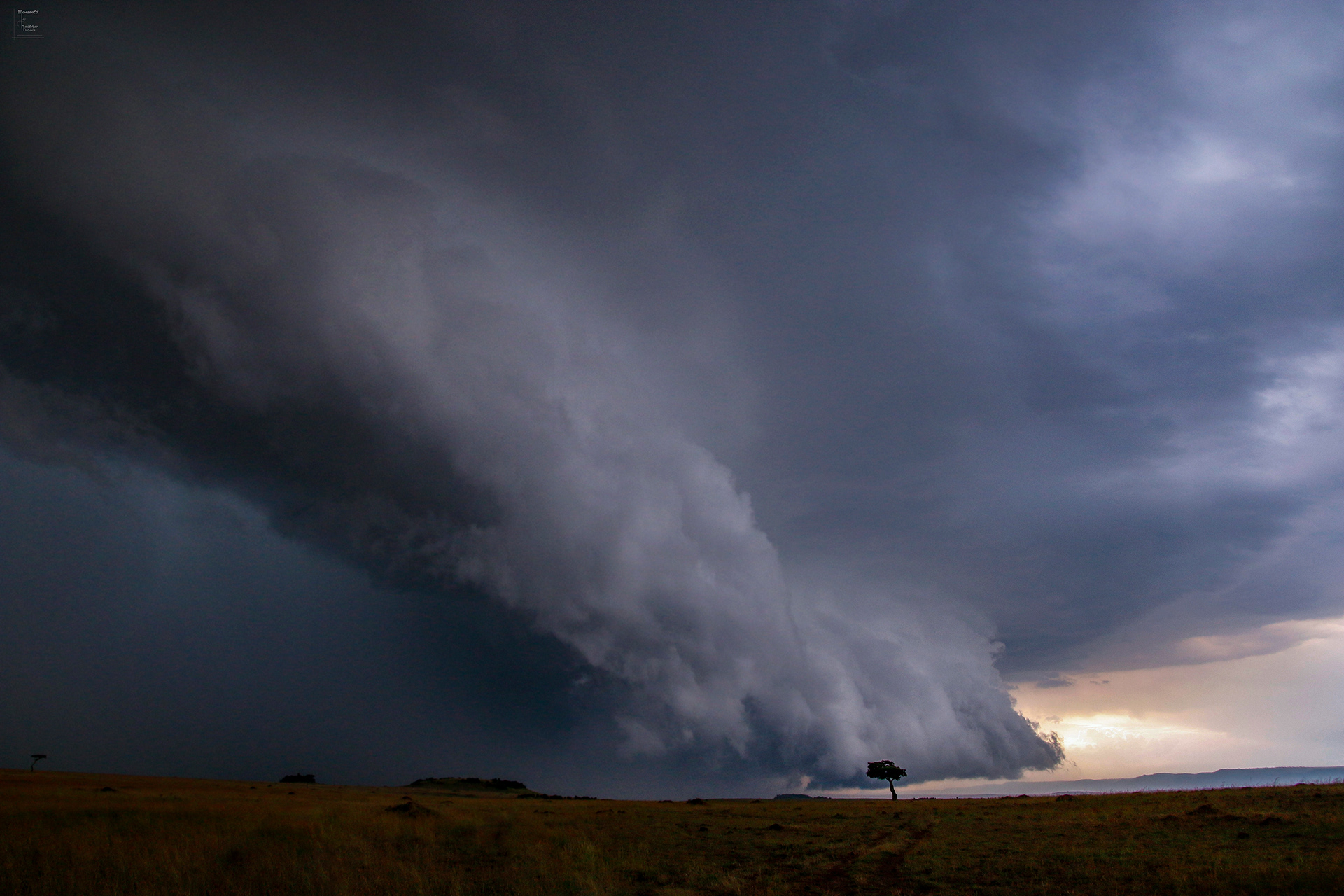
Leading lines refer to lines that lead the viewer’s eye through a photograph. Lines can direct attention to the subject and add depth to a photograph.
When used as a compositional technique, leading lines generally move toward the main subject of a photo. For instance, in this ⬆️ photo, the brooding storm clouds lead your eye to the small but mighty tree. The horizon also leads your eye across the scene.
This technique is frequently used in landscape photography, but it is also fun to explore in various photography styles such as wildlife and portraiture.
Take another look through this newsletter and observe how your eye moves through each image. Are there lines guiding your attention deeper into the frame, or leading you to the subject?
When used as a compositional technique, leading lines generally move toward the main subject of a photo. For instance, in this ⬆️ photo, the brooding storm clouds lead your eye to the small but mighty tree. The horizon also leads your eye across the scene.
This technique is frequently used in landscape photography, but it is also fun to explore in various photography styles such as wildlife and portraiture.
Take another look through this newsletter and observe how your eye moves through each image. Are there lines guiding your attention deeper into the frame, or leading you to the subject?
What do you think?
Want to learn more? Contact me here to schedule a lesson.

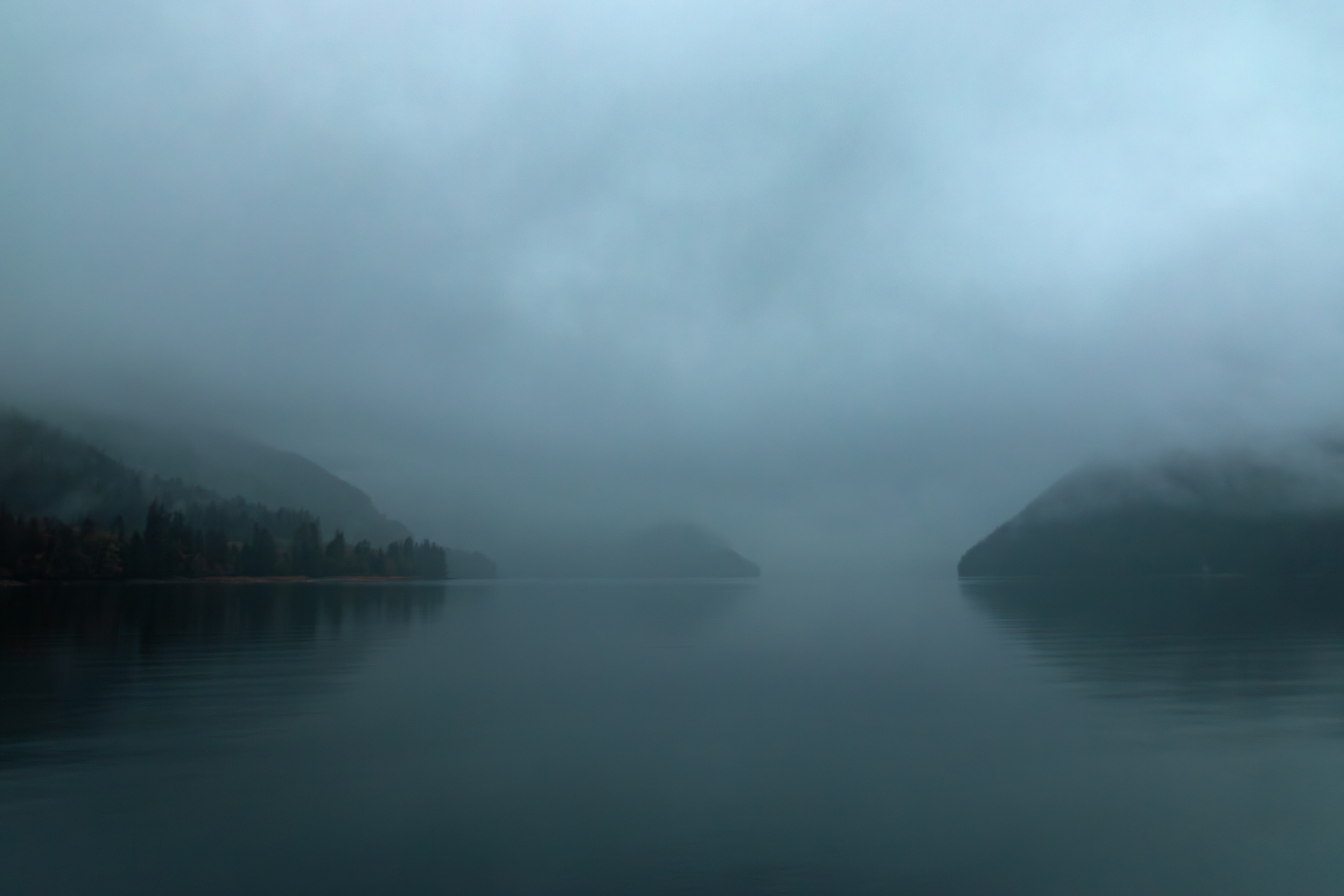
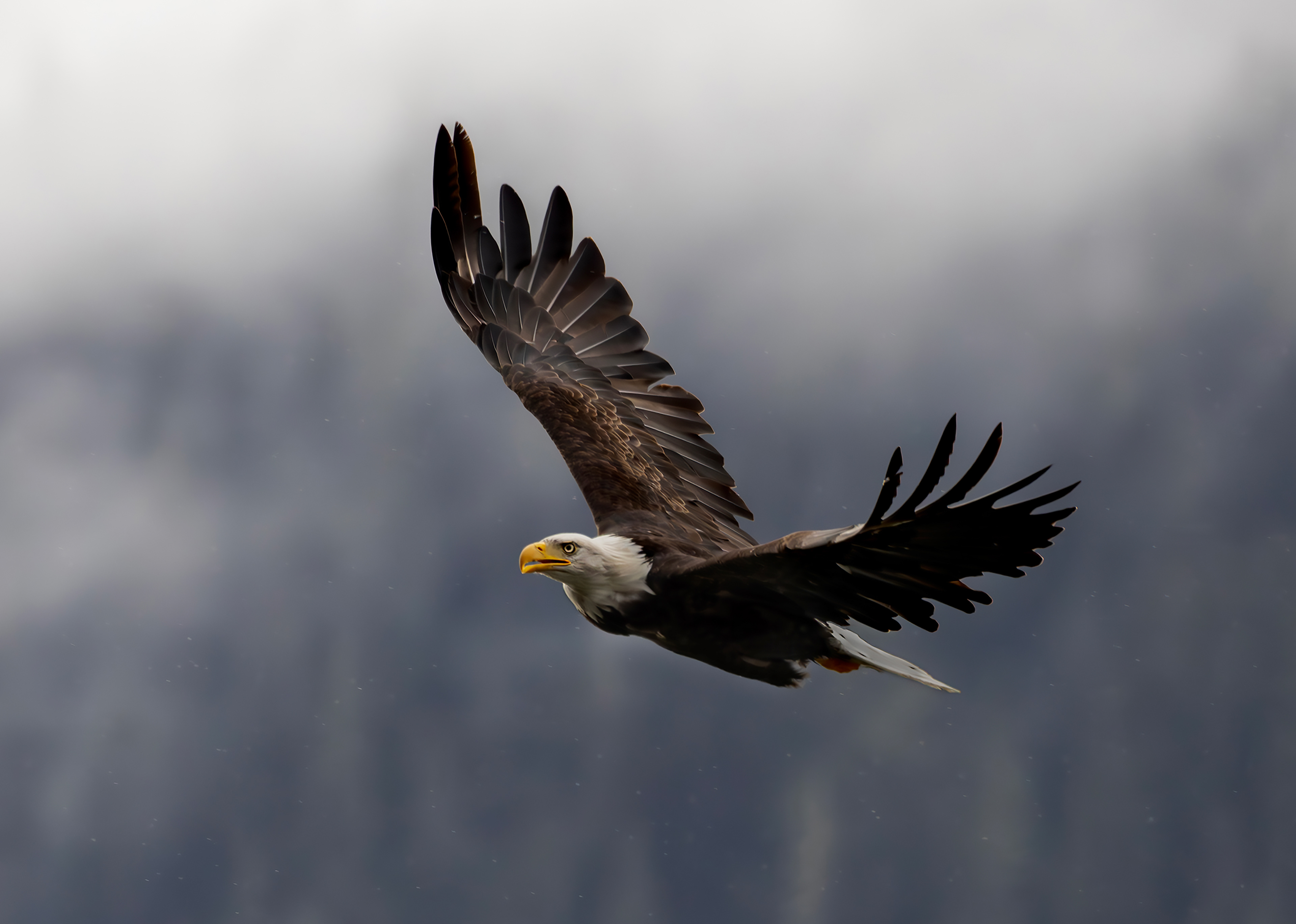
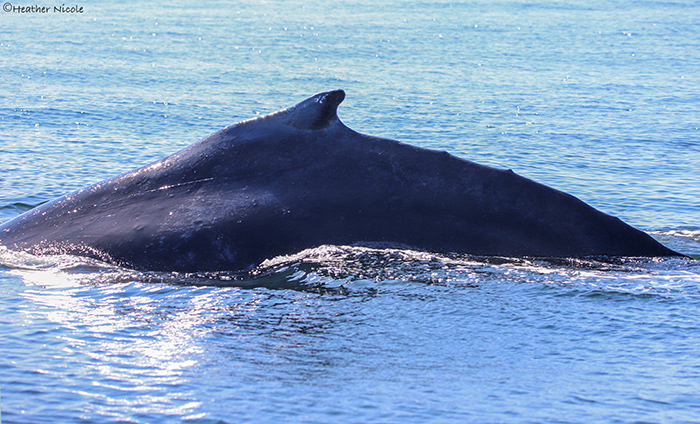
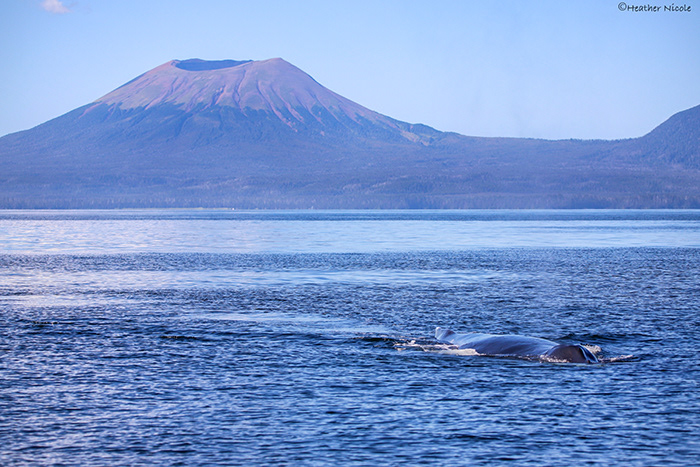
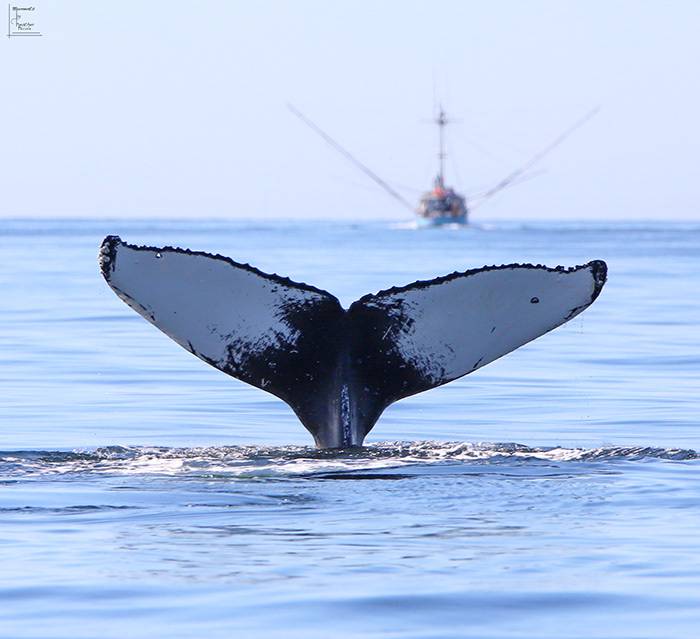
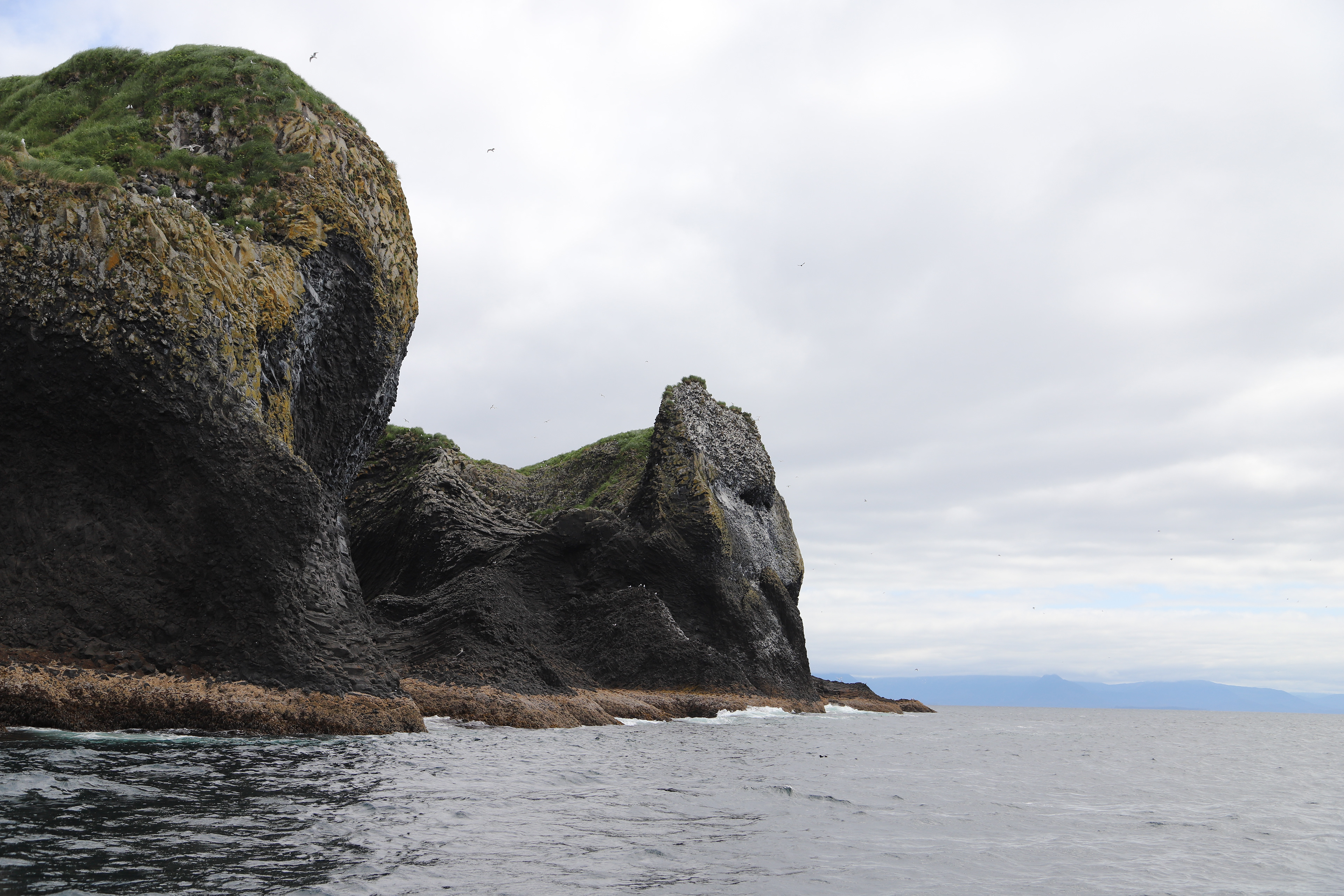
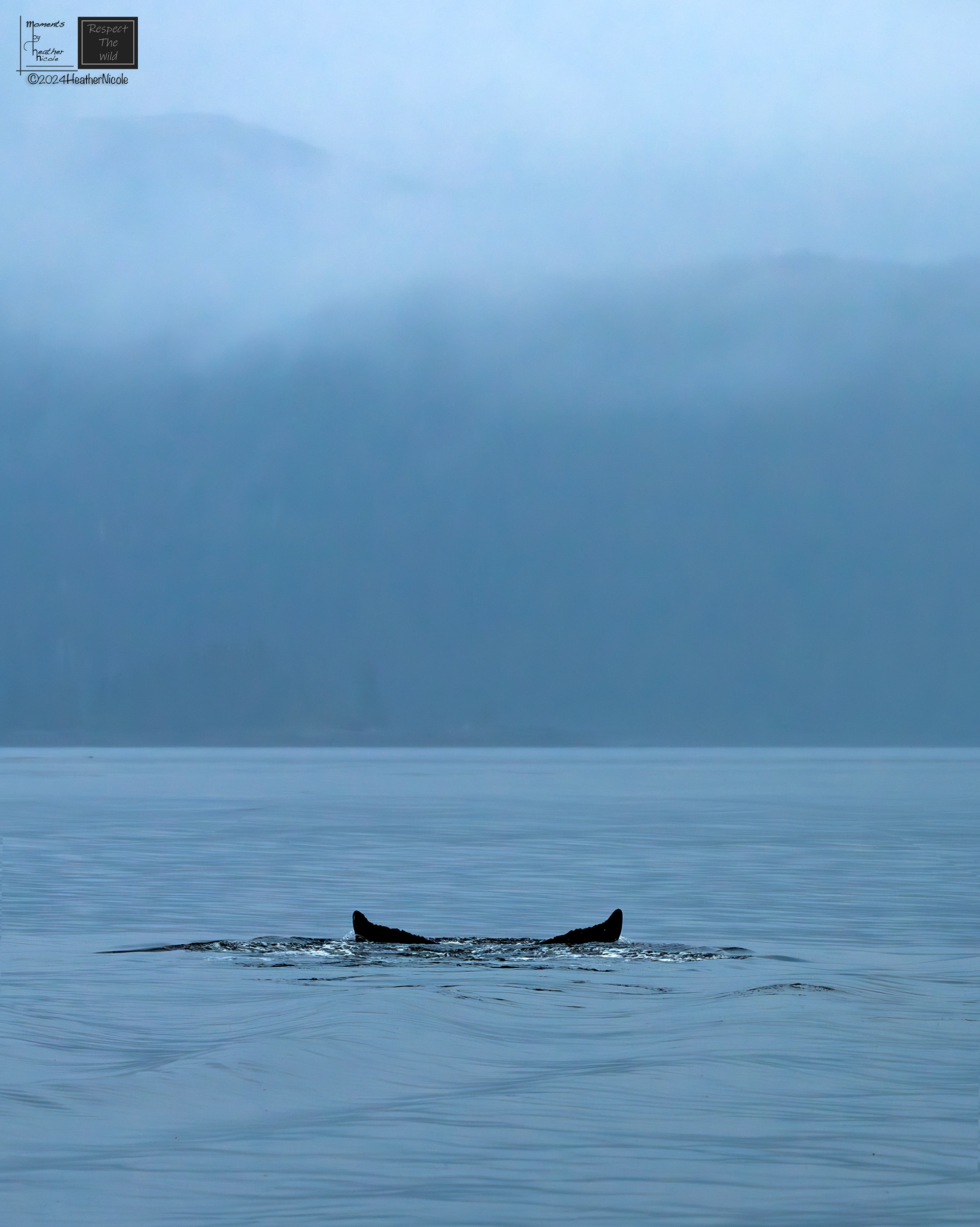
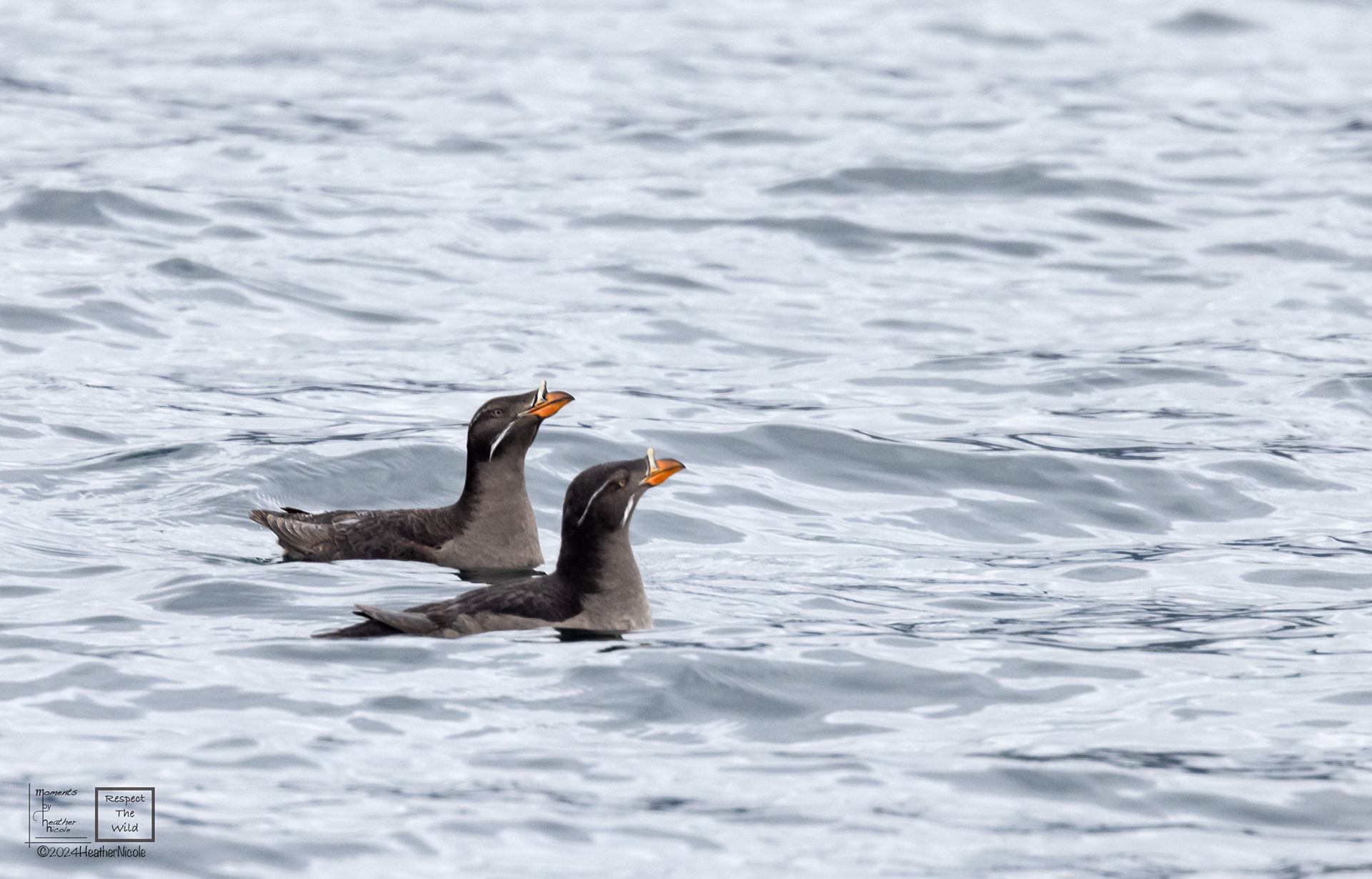
Would you like to travel through the waters of Southeast Alaska with me as your personal photography guide?
There is still time to sign up for this amazing opportunity!
There is still time to sign up for this amazing opportunity!
©MomentsbyHeatherNicole
©MomentsbyHeatherNicole
©MomentsbyHeatherNicole
©MomentsbyHeatherNicole
©MomentsbyHeatherNicole
©MomentsbyHeatherNicole
©MomentsbyHeatherNicole
©MomentsbyHeatherNicole
©MomentsbyHeatherNicole
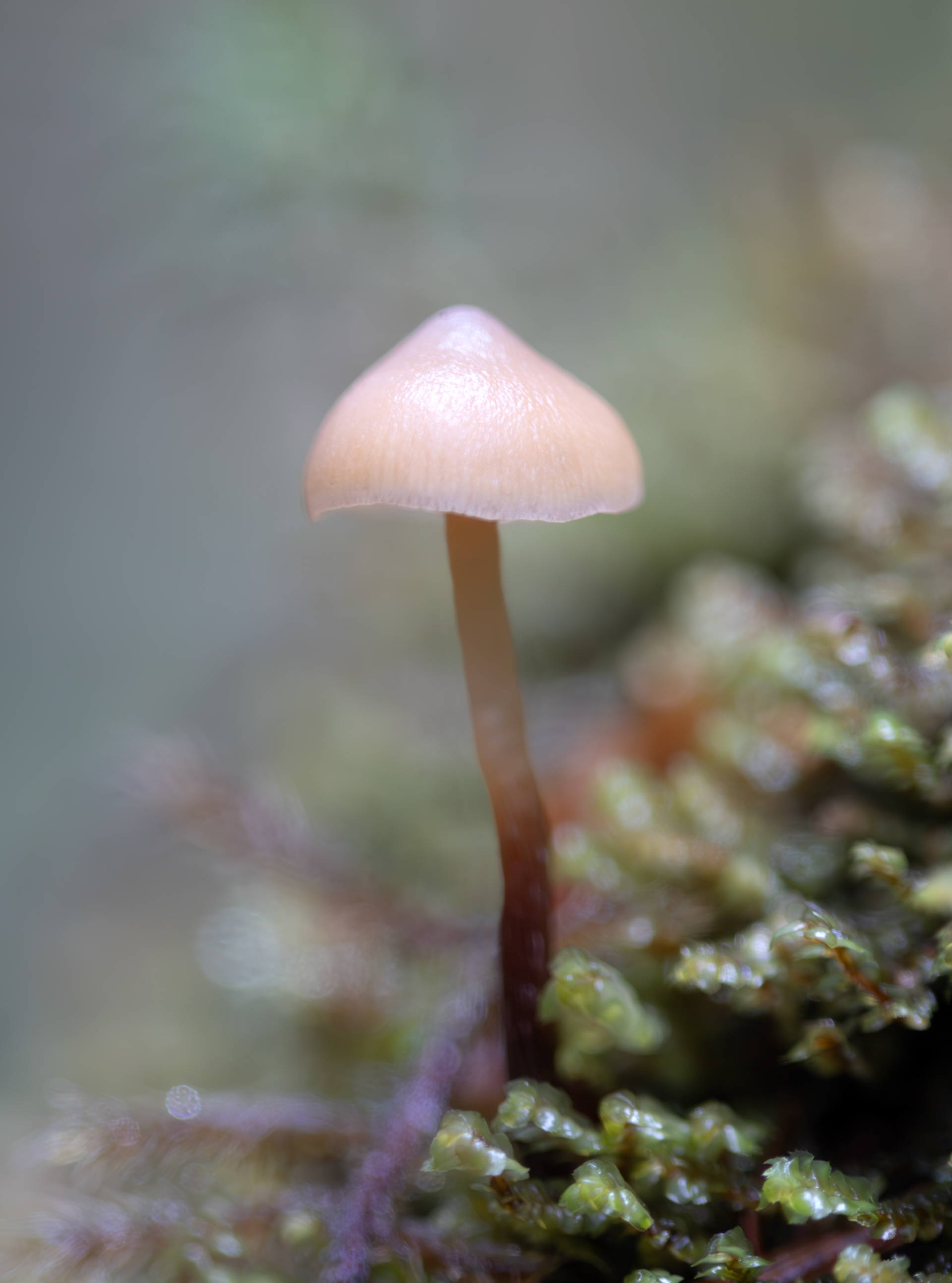
I am partnering with A Whales Song Expeditions to offer a guided photography tour of Seldom Seen Alaska! Our captain and certified naturalist will guide us through the rich, vibrant waters, lush landscapes, and icy fjords of the Alexander Archipelago bringing us close to iconic Alaskan wildlife such as whales, bears, otters, eagles, and so much more; always while keeping a safe and respectful distance. I will offer one-on-one ethical wildlife photography guidance as well as tips & tricks, techniques & critiques to help you bring your photography knowledge to the next level and ensure you make the most of this once-in-a-lifetime adventure. Unlike other photography trips to Alaska, this expedition is both a workshop and an adventure, covering up to 1,000 nautical miles to chase the best light and wildlife action. You’ll refine your skills in tracking eagles in flight, stabilizing shots on a moving boat, and dialing in the perfect settings for Alaska’s ever-changing conditions. Learn to tell powerful visual stories through ethical wildlife photography, master post-processing techniques, and receive real-time feedback from an expert...me! After a day of capturing nature’s finest moments and sharpening your skills, you’ll unwind in remote lodges – recharging both your energy and your gear – ready to frame the next day’s adventure.
Available Dates:
May 1-9, 2027
June 3-11 2027
June 3-11 2027
If you or someone you know is interested, please contact me directly by clicking here. Or simply send me an email at MomentsbyHeatherNicole@gmail.com. I look forward to speaking with you about this adventure opportunity!

Where to find me and my work...
Greenland!
We will be traveling to Greenland with Motherbear Expeditions, August 21-31, 2026. We hope to document polar bears, musk ox, whales, glaciers, towering icebergs, and so much more! I will be sharing photos and stories from that journey in late 2026. Stay Tuned!
Reno-Tahoe International Art Show (RTIA)
We will have a gallery space in the 2026 RTIA show! Come see us September 17-20, 2026
Tickets are on sale now! Don't forget to use code "WHOKNEW26" to receive a 20% friends and family discount!
Tickets are on sale now! Don't forget to use code "WHOKNEW26" to receive a 20% friends and family discount!
Workshops, Presentations, & Lectures
I really enjoy presenting my photography and telling stories about my experiences and the importance of ethical wildlife photography. If you'd like me to speak at your event or club, let's talk! Please contact me here to book me for a presentation or photography talk.
Did you know I teach photography workshops and one-on-one lessons? Contact me today to learn more!
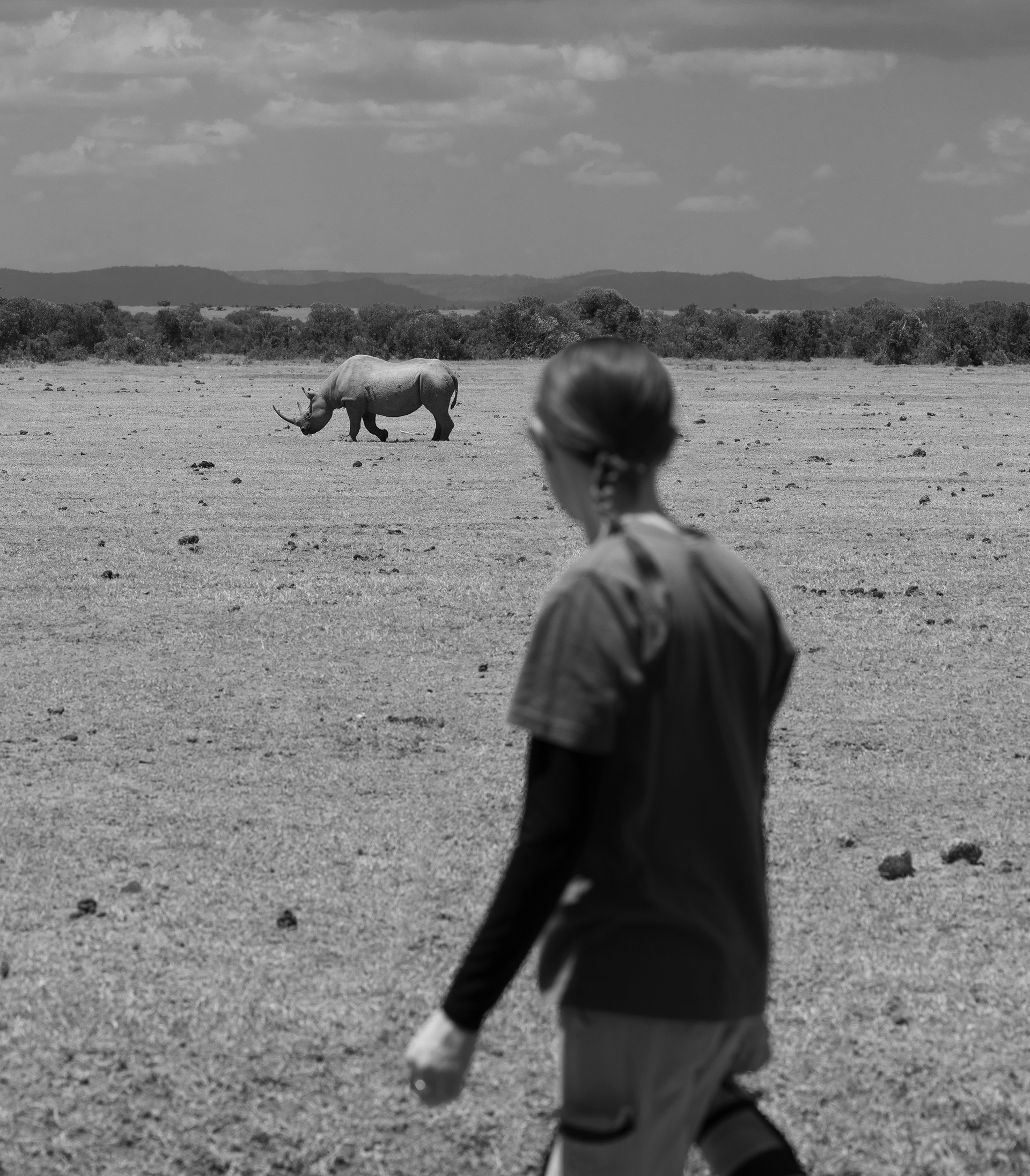

Connecting you to the wild through ethical visual storytelling.
Please click here to visit RespectTheWild.org and learn more about this exciting new venture. If you or someone you know would like to join our mission, please click here to contact us directly. (Or email us at RespectTheWild.org@gmail.com) Let's collaborate and respectfully spread awareness about the importance of respecting Mother Nature and all of her inhabitants.

Thank you!
Thank you so much for spending a little time with my photography.
Find more about me and my work at Moments by Heather Nicole
Find more about my new venture Respect The Wild
Find more about my new venture Respect The Wild
Have you missed a newsletter? Find links to all of my previous newsletters HERE!
Let me know your thoughts. What else would you like to see from me?
Thank you so much for your support and encouragement. It truly means so much to me! 🥰
Please share this newsletter with anyone you think may be interested!
Thank you so much for your support and encouragement. It truly means so much to me! 🥰
Please share this newsletter with anyone you think may be interested!
If you no longer want to receive this newsletter, simply send me an email with "unsubscribe" and I will remove you from the list. No questions asked. No hard feelings.
Enjoy your day.
Enjoy the wild—Respectfully.

©2026MomentsbyHeatherNicole All Rights Reserved